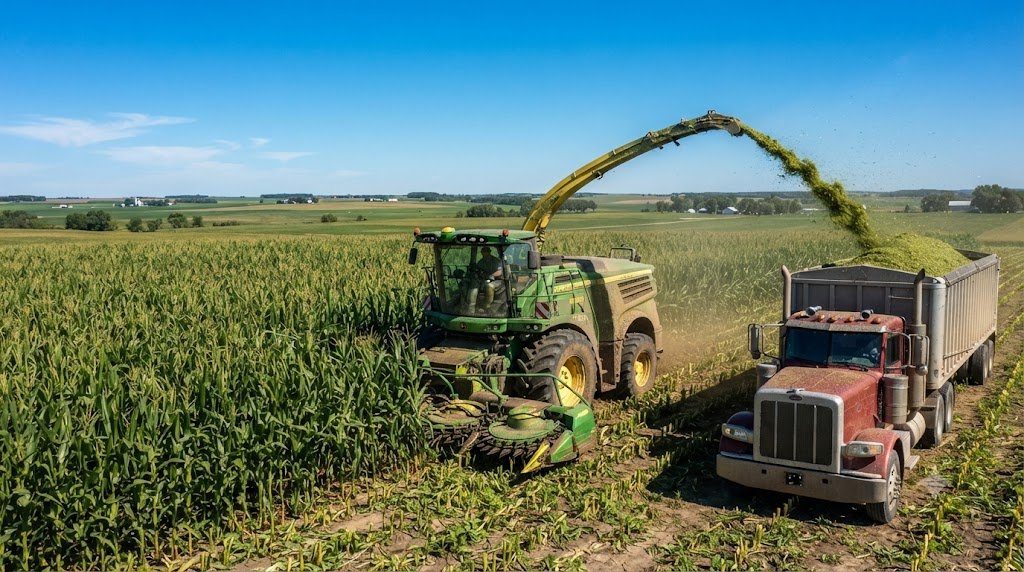
In the livestock, dairy, and commercial biogas sectors, high-quality forage and silage represent the indispensable nutritional foundation of herd productivity and energy output. Harvesting whole-plant corn silage, high-density alfalfa haylage, and sorghum at peak nutritional maturity demands specialized machinery operating at extreme throughput rates. The Self-Propelled Forage Harvester (SPFH) is among the most powerful and mechanically sophisticated machines in agricultural mechanization, frequently harnessing 600 to over 1,000 engine horsepower. Unlike grain combines that thresh and clean, an SPFH chops high-moisture whole crops into microscopic, uniform particle lengths while pulverizing grain kernels to ensure optimal anaerobic fermentation and bovine ruminal starch availability.
1. High-Tonnage Intake: Feed Roll Dynamics and Metal Detection Protection
The intake system of an SPFH must compress enormous volumes of fluffy, bulky forage into a solid, high-density crop mat before delivering it into the spinning cutterhead. This critical compression is accomplished by four or six heavy hydraulic feed rolls.
The lower feed rolls rotate on fixed bearings, while the upper rolls are mounted on massive spring-loaded or hydropneumatically loaded swing arms capable of opening several inches to accommodate massive crop surges. Independent variable-displacement hydraulic motors drive the feed rolls. By modulating feed roll rotational speed relative to the fixed cutterhead speed, the operator adjusts the theoretical length of cut (TLOC)—typically between 3.5 mm and 28 mm—directly from the cab touch terminal.
Metal and Stone Detection Systems
A single metallic bolt, broken rake tooth, or fencing wire entering an SPFH cutterhead spinning at 1,200 rpm would shatter knives, destroy the shear bar, and cause tens of thousands of dollars in catastrophic damage. To eliminate this risk, the lower front feed roll contains powerful integrated electromagnet coils.
When any ferrous metal object disturbs the magnetic field, the sensor triggers a high-speed solenoid that releases a spring-loaded mechanical pawl. The pawl locks into a ratchet ring on the feed roll drive within a fraction of a millisecond, halting feed roll rotation instantly while the cutterhead continues spinning safely without ingestion. The operator then reverses the feed rolls to eject the foreign object safely onto the field.
Audit metal detector trip sensitivity daily before commencing harvesting operations. Pass a certified test steel sphere along the full width of the feed rolls to verify that both left, center, and right sensor coils trip the emergency stop pawl reliably across all operational gears.
2. Drum Cutterhead Geometry and Scissor-Cut Kinematics
The engineering core of the forage harvester is the heavy cylindrical drum cutterhead. Ranging from 600 to over 800 mm in diameter, the drum is fitted with 20 to 36 angled, hardened alloy steel knives arranged in chevron or V-shaped patterns.
The cutting action does not rely on blunt impact; it is a true precision scissor cut executed between the rotating knife edge and the stationary, tungsten carbide-faced shear bar. The angled chevron knife configuration ensures that knives enter the crop mat progressively from the outer edges toward the center. This progressive entry dampens shock vibrations, prevents crop bunching, and reduces peak engine horsepower requirements by up to 15% compared to straight-across knife designs.
| Crop Type | Target Theoretical Cut Length (TLOC) | Knife Drum Configuration | Kernel Processor Gap | Target In-Silo Moisture Content |
|---|---|---|---|---|
| Corn Silage (Standard) | 12 – 19 mm | Full set (28–36 knives) | 1.5 – 2.5 mm | 63% – 68% Moisture |
| Shredlage® Corn Silage | 26 – 30 mm | Half set (14–18 knives) | 1.0 – 1.5 mm | 65% – 68% Moisture |
| Alfalfa / Grass Haylage | 8 – 14 mm | Full set (28–36 knives) | Removed / Disengaged | 55% – 65% Moisture |
| Whole-Crop Cereal Silage | 10 – 16 mm | Full set (28–36 knives) | 1.5 – 2.0 mm | 60% – 65% Moisture |
| Biogas Sorghum / Biomass | 4 – 8 mm (Micro-cut) | Specialized 40–48 knife drum | Disengaged | 68% – 72% Moisture |
3. Automated Knife Sharpening and Shear Bar Adjustment Cycles
Maintaining razor-sharp knife edges and microscopic knife-to-shear-bar clearances is non-negotiable in forage harvesting. A dull knife edge tears rather than shears plant fibers, resulting in ragged, uneven particle lengths, poor silage pack compaction in the bunker silo, and up to a 30% increase in diesel fuel consumption.
Modern SPFH platforms integrate fully automated in-cab sharpening systems:
- Automated Sharpening Stone Traversal: An abrasive sharpening stone mounted on a motorized carriage traverses back and forth across the spinning cutterhead. The operator initiates the sharpening cycle from the cab; the cutterhead reverses rotation, and the stone grinds a uniform, razor-sharp bevel across all knife edges in 2 to 3 minutes.
- Acoustic Shear Bar Knock Sensors: After sharpening, the shear bar must be adjusted to within 0.1 to 0.2 mm of the spinning knives. Electric stepper motors advance both ends of the shear bar toward the drum. Acoustic knock sensors mounted on the shear bar detect the microscopic vibration of the first knife touch. The system immediately halts adjustment, retracts the shear bar by a programmed micro-fraction, and locks it in place—achieving perfect scissor clearance without manual wrenching.
A shear bar gap exceeding 0.5 mm increases harvester fuel burn by 1.2 to 2.0 liters per harvested ton. Running an automated sharpening and shear bar calibration cycle every 250 to 300 tons of harvested crop pays for itself many times over in immediate diesel fuel savings and improved silage fermentation quality.
4. Kernel Processing (Crop Processor) Mechanics: Cracking Starch Barriers
In whole-plant corn silage, starch locked inside the corn kernel represents the primary dietary energy source for dairy cattle. However, whole or partially cracked corn kernels pass through the bovine digestive tract undigested, wasting vital nutrients.
Directly behind the cutterhead, chopped corn enters the Kernel Processor (KP). The KP consists of two heavy, hardened steel rollers spinning toward each other at high velocity with an aggressive differential speed ratio (typically 20% to 50% differential):
Standard Fluted / Sawtooth Rollers
Sawtooth rollers running with a 1.5 to 2.5 mm gap smash and shear corn kernels into four or more fragments, rupturing the tough pericarp seed coat so rumen microbes can ferment the internal starch.
Cross-Cut and Shredlage® Rollers
Shredlage® rollers feature deep counter-rotating cross-grooves with a 30% to 50% speed differential. In addition to pulverizing kernels into dust, these aggressive rollers rip corn stalks longitudinally into long, shredded fibers. This allows dairy operations to harvest at longer cut lengths (26 to 30 mm), providing beneficial physical effective fiber (peNDF) that stimulates rumination while ensuring 98%+ kernel processing scores (CSPS).
5. Crop Accelerator Blower and High-Velocity Discharge Spout
After passing through the cutterhead and kernel processor, chopped forage has surrendered most of its kinetic forward momentum. To propel this dense, high-moisture stream up the discharge chute and into trailing or adjacent silage trucks, the machine relies on the Crop Accelerator.
The accelerator is a heavy centrifugal paddle blower drum spinning at 1,800 to 2,100 rpm. The distance between the accelerator paddle tips and the wear housing is hydraulically adjustable from the cab. Setting the housing tight for light haylage and wider for dense corn silage optimizes air throw velocity while minimizing parasitic engine drag.
The high-strength steel discharge spout rotates 210 degrees and elevates up to 6 meters. Modern SPFH machines feature 3D camera-based Active Fill Control. Computer vision algorithms track the dimensions of adjacent silage trailers, autonomously steering the spout and deflecting the spout flap to fill trailers uniformly from front to back without spilling forage on the field.
6. Biological and Chemical Silage Inoculant Dosing Systems
Preserving the nutritional value of chopped forage requires rapid anaerobic lactic acid fermentation in the silage bunker. Modern forage harvesters carry integrated biological inoculant injection packages delivering precise dosages of lactic acid bacteria (e.g., Lactobacillus plantarum and L. buchneri) or chemical organic acid preservatives.
Dosing rates are modulated in real time based on instantaneous yield and near-infrared (NIR) moisture data. An onboard peristaltic pump meters concentrated bacterial inoculant at rates between 10 and 50 milliliters per ton directly into the crop stream at the accelerator blower housing, ensuring complete, homogenous coverage across every plant fiber.
7. Near-Infrared (NIR) Spectroscopy: Real-Time Nutrient Mapping
Advanced forage harvesters function as mobile nutritional laboratories utilizing Near-Infrared (NIR) sensor technology mounted directly in the discharge spout. As crop stream shoots past the optical glass sensor window, the NIR spectrometer measures reflected light wavelengths hundreds of times per second.
Calibrated chemometric algorithms analyze the spectral data in real time, calculating:
- Moisture / Dry Matter Content (DM %): Used for automated length-of-cut adjustment (chopping longer in high-moisture forage to prevent bunker seepage, and shorter in dry forage to ensure tight compaction).
- Crude Protein (%): Maps field nitrogen assimilation and forage quality.
- Acid Detergent Fiber (ADF) & Neutral Detergent Fiber (NDF): Determines fiber digestibility.
- Starch Content (%): Measures kernel development and energy density.
8. Maintenance Protocols for High-Horsepower Harvester Survivability
Operating at 800+ horsepower in abrasive, acidic crop sap demands rigorous daily preventative maintenance:
- Wear Plate Thickness Auditing: Inspect replaceable hardox steel wear plates lining the cutterhead floor, accelerator housing, and spout transition elbow. Abrasive sand and crop fibers wear through steel linings rapidly; failing to replace wear liners leads to structural frame blowouts.
- Kernel Processor Belt and Bearing Checks: Check KP drive belt tension and monitor roller bearing temperatures with an infrared thermometer daily. High-differential KP rollers generate immense friction heat; failing bearings can ignite dry crop chaff.
- Central Automatic Lubrication Inspection: Audit the automated grease pump reservoir daily. Verify that grease delivers to all 60+ pivot points, especially the high-speed feed roll swing arms and main blower bearings.
- Engine Air Pre-Cleaner Maintenance: Clean the rotary screen air pre-cleaner daily to prevent radiator core clogging from airborne alfalfa chaff and corn husks, ensuring engine coolant temperatures stay within safe operating thresholds.
9. High-Moisture Silage Compaction and Aeration Dynamics
The mechanical efficiency of a self-propelled forage harvester directly governs the biological success of silage fermentation inside the bunker silo. When whole-plant corn or alfalfa is chopped, every millimeter of variation in particle length impacts bulk packing density.
Targeting an optimal Theoretical Length of Cut (TLOC) of 15 to 19 mm for corn silage allows heavy packing tractors (weighing 15 to 25 metric tons) to achieve target bunker pack densities exceeding 240 kg of dry matter per cubic meter (15 lbs DM/ft³). Rapid packing expels atmospheric oxygen within hours, allowing beneficial homofermentative lactic acid bacteria to rapidly lower silo pH below 4.0, which prevents spoilage by yeasts, clostridial bacteria, and molds.
If forage is chopped too long (exceeding 25 mm without Shredlage® processing), the coarse stalks resist compaction, creating stubborn oxygen pockets that allow aerobic fungi and heating yeasts to consume sugars, resulting in unpalatable, brown caramelized silage and dangerous mycotoxin accumulation.
Kernel Processor Roll Differential Speed Tuning
For whole-crop corn silage, kernel processor rolls typically operate with a 20%, 30%, or 50% rotational speed differential. In extremely hard, mature corn (black-layer kernel stage with dry matter exceeding 38%), technicians should install high-differential drive pulleys (40% to 50% speed differential). The violent shearing and tearing action strips the hard vitreous starch matrix apart, ensuring over 95% of kernels are completely pulverized to maximize dairy milk production.
10. Daily Inspection and Sharpening Workflow for 1,000-Horsepower Harvesters
Operating high-capacity forage harvesters demands an uncompromising daily maintenance schedule:
- Cutterhead Knife Torque Auditing: Check the torque of every knife retaining bolt every 50 operating hours using a calibrated torque wrench (typically 220 to 260 Nm). A loose knife bolt can allow a knife to shift slightly, striking the shear bar and destroying the entire drum in a fraction of a second.
- Sharpening Stone Wear Profile: Inspect the abrasive sharpening stone for grooving or uneven taper. Replace worn stones promptly to ensure they grind a perfectly flat, uniform bevel across the entire width of all knives.
- Kernel Processor Gap Zero-Point Check: Use feeler gauges to verify that when the in-cab monitor reads a 1.5 mm KP gap, the physical clearance between the upper and lower processing rolls matches exactly across both left and right sides.
- Blower Housing Wear Liner Clearance: Measure the clearance between the crop accelerator paddle tips and the Hardox steel wear band. Maintain a tight 2 to 3 mm clearance to ensure maximum air velocity throw into trailing silage trucks without power-sapping blowback.
- Auto-Lubrication Pump Reservoir Inspection: Audit the automated grease pump reservoir daily, confirming grease is delivered under pressure to feed roll pivot bearings, main drum bearings, and accelerator pillow blocks.


