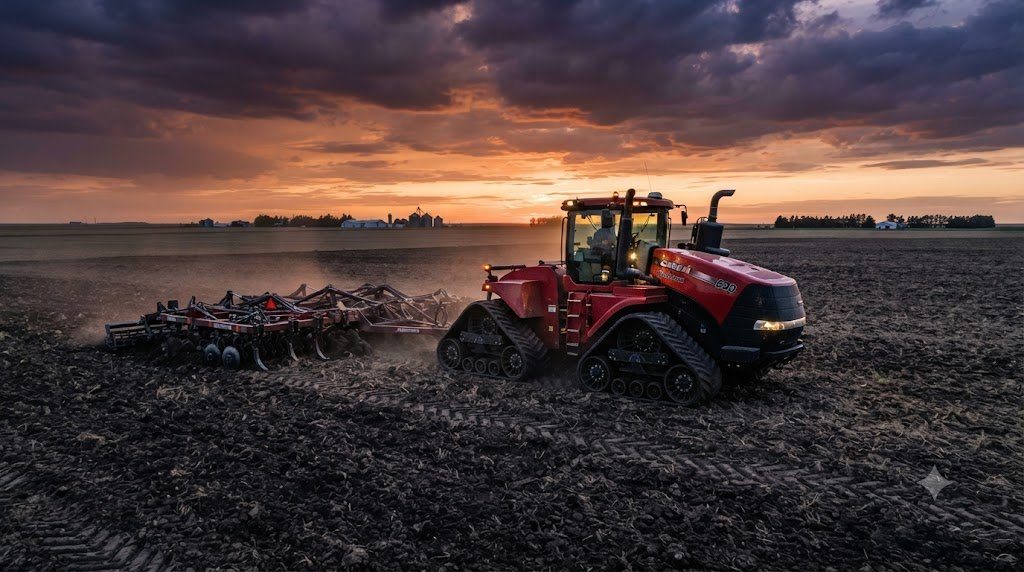
When agricultural operations scale to thousands of contiguous acres requiring deep primary tillage, high-speed land leveling, or broad-acre seeding rigs spanning 60 to 90 feet in width, standard mechanical front-wheel-drive tractors encounter physical limitations in drawbar pull and weight distribution. In these demanding commercial environments, high-horsepower articulated four-wheel-drive (4WD) wheeled tractors and continuous rubber quad-track machines representing 450 to over 650 engine horsepower become the operational backbone of broadacre farming. Maximizing the tractive potential of these heavy industrial machines demands deep comprehension of center articulation kinematics, ground contact pressure dynamics, track tensioning hydraulics, and subsoil compaction mitigation strategies.
1. Center Articulation Kinematics and Oscillation Joint Mechanics
Unlike conventional row-crop tractors that execute steering through pivoting front spindle assemblies, articulated tractors feature two independent chassis frames—a front engine frame and a rear axle/implement frame—joined by a massive central articulation and oscillation hitch. This mechanical joint provides two distinct degrees of rotational freedom: horizontal steering yaw and vertical axial oscillation.
Steering is actuated by twin double-acting hydraulic cylinders operating in push-pull opposition across the articulation joint. By articulating the entire chassis up to 38 to 42 degrees, the rear tires or tracks follow closely within the path cleaved by the front units during steady-state turns, minimizing the total surface area of soil subjected to wheel traffic compared to front-wheel steer tractors pulling trailing implements.
Simultaneously, the central oscillation joint allows the front and rear chassis frames to rotate up to 15 degrees axially relative to one another. This oscillation ensures that all four drive units—whether massive dual radial tires or continuous rubber track assemblies—maintain continuous, unyielding ground contact when navigating terrace ridges, drainage swales, and rough furrow transitions. Maintaining continuous four-corner contact prevents localized chassis twisting stresses, avoids abrupt wheel lift, and ensures that tractive torque is distributed symmetrically across all drive axles.
The engineering design of the central hitch employs spherical self-aligning bearings with heavy induction-hardened steel pins measuring over 75 to 100 millimeters in diameter. High-tensile bronze or composite thrust washers absorb horizontal draft impact forces generated when pulling heavy 18-shank deep rippers through compacted subsoil layers.
Inspect the center articulation pins, spherical bearings, and oscillation sleeve thrust washers every 500 operating hours. Excess play exceeding 1.5 millimeters can induce severe high-speed transport sway, accelerate hydraulic steering cylinder seal extrusion, and lead to catastrophic structural cracking of the center cast hinge frames under heavy drawbar torsional loads.
2. Soil Compaction Physics: Ground Contact Pressure vs. Axle Load
Heavy agricultural machinery presents an inherent conflict between the ballast mass required to generate high tractive pull and the risk of inducing severe subsoil compaction that permanently degrades soil health. Soil compaction occurs through two distinct mechanical phenomena that must be differentiated by equipment managers:
Surface Compaction (Top 0 to 12 Inches)
Surface compaction is directly proportional to ground contact pressure, measured in pounds per square inch (PSI) or kilopascals (kPa). Ground contact pressure is determined by the tire inflation pressure, tire carcass deflection, or track footprint area. When ground pressure exceeds 15 to 18 PSI, soil pores in the topsoil collapse, restricting seed germination, seedling emergence, and early fibrous root development.
Subsoil Compaction (Depths Exceeding 12 Inches)
Subsoil compaction is governed primarily by total axle load rather than surface contact pressure. Regardless of how wide a tire or track footprint is, if a machine’s total axle load exceeds 10 to 12 metric tons, destructive compression stresses penetrate deep into the subsoil below normal tillage depths. This creates a dense, impenetrable hardpan layer that severely inhibits downward water percolation, causes seasonal perched water tables, and starves deep plant taproots of oxygen during peak vegetative growth phases.
Field trials demonstrate that severe subsoil compaction can depress crop yields by 10% to 25% for multiple consecutive growing seasons, requiring costly deep mechanical ripping or multi-year taproot cover crop remediation to restore natural soil hydrology and bulk density equilibrium.
| Chassis Configuration | Total Machine Weight | Contact Footprint Area | Average Ground Pressure | Subsoil Compaction Risk |
|---|---|---|---|---|
| Articulated Dual Wheels | 24,500 – 28,000 kg | 2,800 – 3,200 sq. in. | 14 – 18 PSI (96–124 kPa) | Moderate to High (dependent on moisture) |
| Articulated Triple Wheels | 26,000 – 30,500 kg | 4,200 – 4,800 sq. in. | 10 – 13 PSI (69–90 kPa) | Moderate (wide surface disturbance) |
| Quad-Trac Rubber Tracks | 26,500 – 31,000 kg | 5,600 – 6,400 sq. in. | 6.5 – 8.5 PSI (45–59 kPa) | Low surface / Moderate subsoil |
| Twin-Track High-Power | 23,000 – 26,000 kg | 4,800 – 5,400 sq. in. | 7.5 – 9.5 PSI (52–65 kPa) | Low surface / High steering berming |
3. Continuous Rubber Quad-Track Undercarriage Architecture
To reconcile the demands of extreme tractive force and soil protection, quad-track undercarriages have achieved prominent adoption across commercial broadacre farming. A four-track system replaces individual wheeled axle ends with independent, triangular track modules featuring a top drive wheel, lower mid-rollers, and front and rear idler wheels.
Positive drive track systems utilize cast polyurethane drive lugs vulcanized along the inner circumference of the continuous rubber belt, which interlock directly with matching drive wheel cogs. This mechanical gear-tooth engagement eliminates belt slippage even in saturated, greasy clay conditions where friction-drive twin-track belts frequently lose traction against smooth steel drive wheels.
The lower mid-rollers are mounted on articulated walking-beam bogies with polyurethane suspension elements or oil-damped nitrogen accumulators. As the track traverses over stones, rocks, and uneven ruts, each mid-roller oscillates independently, distributing machine weight uniformly across the entire length of the ground contact patch. This uniform weight distribution avoids high-pressure localized stress spikes that occur beneath rigid non-suspension rollers, ensuring consistent traction and smooth operating comfort at field speeds up to 14 km/h.
Furthermore, because the four track modules oscillate independently across both horizontal and vertical planes, quad-track machines eliminate the aggressive headland soil berming and ridge gouging characteristic of two-track skid-steered tractors. The operator can execute full-power turns while maintaining positive drive engagement on all four tracks without tearing up established seedbeds.
4. Automatic Track Tensioning and Hydraulic Calibration
Proper track belt tension is vital for operational longevity and energy efficiency. Under-tensioned track belts risk jumping drive lugs under heavy torque loads, causing severe internal steel cable fracturing and catastrophic lug shearing. Over-tensioned tracks impose massive parasitic side-bearing loads on final drive bearings, dramatically accelerate track idler bushing wear, and overheat track rubber compounds during road transport.
Modern quad-track systems utilize automated electro-hydraulic tensioning circuits. A dedicated high-pressure hydraulic tension cylinder continuously acts on the front idler wheel fork, maintaining belt tension between 180 and 220 bar (2,600 to 3,200 psi). Nitrogen-charged bladder accumulators plumbed directly into the tension circuit absorb instantaneous shock loads when debris or hardened soil clods pass between the track belt and internal idlers, preventing hydraulic pressure spikes that could burst high-pressure oil lines or damage internal undercarriage castings.
Technicians must regularly inspect track internal guide lugs for signs of scuffing or misalignment. Guide lugs align the belt between mid-roller flanges; excessive guide lug wear indicates undercarriage frame toe-in or camber deflection requiring alignment shim adjustment.
Regularly inspect track drive lugs and guide lugs for asymmetrical edge wear. Guide lug rubbing against the sides of the mid-rollers indicates track frame misalignment. Re-align track undercarriage frames promptly using factory alignment shims or eccentric adjustment collars to avoid irreversible belt edge fraying.
5. Heavy Draft Implement Pull Dynamics and Dynamic Ballasting
Unlike row-crop tractors where a significant percentage of engine horsepower is diverted to PTO shafts or hydraulic planter motors, high-horsepower articulated tractors operate primarily as pure draft machines. In deep ripping, heavy disc ripping, and broadacre chisel plowing, drawbar draft forces frequently exceed 120 to 180 kilonewtons of sustained pull.
Managing these massive draft forces requires exact ballast configuration. On an articulated wheeled tractor, static weight distribution should target 55% on the front axle and 45% on the rear axle. Under heavy drawbar pull, dynamic weight transfer shifts mass rearward, yielding an ideal 50/50 balance during continuous field work.
For quad-track platforms, because the center of gravity is positioned lower and the track footprints distribute weight over an elongated longitudinal plane, static weight distribution is typically balanced closer to 50% front and 50% rear from the factory. Operators must avoid adding excessive cast iron suitcase weights unless pulling extremely deep subsoilers in hard, dry soil where track slip exceeds 8%. Excessive ballast simply increases unnecessary fuel burn without providing measurable tractive gains.
Calculating theoretical drawbar pull capability is achieved using the tractive efficiency equation:
$$\text{Drawbar Pull (kN)} = \frac{\text{Engine Power (kW)} \times \text{Tractive Efficiency (\%)}}{\text{Ground Speed (m/s)}}$$
For a 450 kW (600 hp) quad-track operating at 80% tractive efficiency at a working velocity of 2.5 m/s (9.0 km/h), the machine delivers an astonishing 144 kilonewtons of continuous drawbar pull, easily handling 60-foot disc rippers through tough gumbo clay.
6. High-Output Hydraulic Auxiliary Packages and Implement Control
Broadacre planters and air seeders pulled by high-horsepower tractors feature massive hydraulic demands, often requiring four to six continuous-flow hydraulic circuits running concurrently to operate dual high-capacity grain fill fans, fertilizer injection motors, ground-drive alternators, and active downforce cylinders.
To meet these requirements without starving the tractor’s primary steering and braking circuits, high-horsepower tractors employ twin-pump dual-circuit hydraulic architectures. One dedicated CCLS pump (e.g., 220 L/min) supplies tractor chassis functions and hitch circuits, while a secondary independent auxiliary pump (delivering an additional 210 to 230 L/min) supplies high-volume remote SCV valves for the trailing implement.
A dedicated high-efficiency hydraulic oil cooler with a thermostatically controlled variable-speed hydraulic fan ensures that hydraulic reservoir fluid temperatures remain below 80°C even during continuous 24-hour planting shifts in high ambient temperatures, preventing hydraulic oil varnish formation and preserving sensitive proportional valve solenoid tolerances.
High-flow 3/4-inch hydraulic quick-connect couplers replace standard 1/2-inch agricultural couplers on high-demand circuits, cutting fluid velocity restrictions in half and eliminating parasitic thermal horsepower losses that can sap 15 to 20 engine horsepower on large air seeding rigs.
7. Heavy Powertrain Lubrication and Axle Planetary Health
The planetary final drive assemblies in high-horsepower tractors endure tremendous mechanical torque magnification, reducing high-speed driveline rotation to low-speed high-torque axle rotation. Each planetary wheel hub contains heavy sun and planet gears operating in extreme-pressure hypoid gear oils.
Technicians must adhere to rigorous fluid sampling and maintenance schedules:
- Axle Planetaries: Change hub oil every 1,000 operating hours using full-synthetic SAE 75W-140 or 80W-140 gear lubricants with specialized anti-foaming and extreme-pressure additives.
- Magnetic Drain Plug Auditing: Inspect magnetic drain plugs on every planetary hub and central differential sump during oil changes. Fine grey metallic paste is normal break-in residue; distinct metallic slivers or flakes indicate impending tooth surface spalling or bearing cage failure.
- Outer Axle Bearings: Grease outer axle pivot bearings daily during heavy field operations to maintain an effective barrier against dust, mud, and water ingress.
- Driveline Universal Joints: Lubricate central driveshaft U-joints and slip yokes every 250 hours, verifying that grease purges evenly from all four bearing cups on each cross journal.
- Differential Lock Solenoids: Test electro-hydraulic differential lock engagement before heavy tillage. Both front and rear differential locks must synchronize smoothly to prevent spinning a single wheel or track module under extreme draft load.
8. Precision Agronomic Impact: Fuel Burn per Acre and Timeliness
Ultimately, high-horsepower articulated and quad-track tractors deliver unmatched agronomic value through operational timeliness. In broadacre grain production, planting and harvesting windows are constrained by seasonal rainfall, soil temperatures, and impending frost. By enabling a single operator to manage a 60-foot tillage rig or an 80-foot precision seeder at 10 to 12 km/h, hundreds of acres can be prepared and seeded per shift.
When matched with automated engine-transmission power management systems and RTK satellite autosteer down to sub-inch accuracy, modern high-horsepower tractors achieve fuel consumption benchmarks under 0.85 gallons per acre in heavy tillage, delivering superior economic return on invested capital while safeguarding vital subsoil hydrology.
Field telematics continuously stream fuel rate per acre, engine torque utilization percentages, and GPS overlap efficiency to farm office dashboards, enabling fleet managers to identify operator habits, optimize gear-and-throttle selections, and schedule servicing before minor wear transforms into costly catastrophic field failures.


